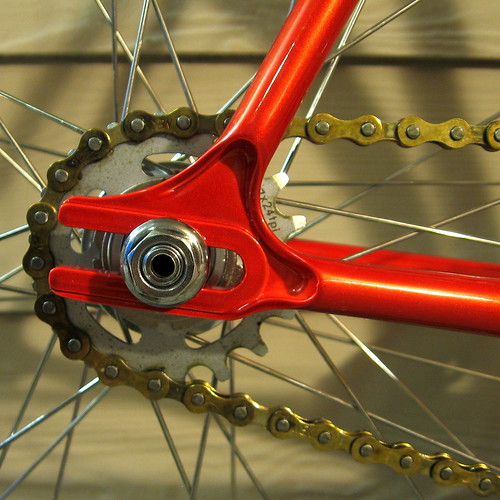
... On the fixie. According to the little top speed calculator thingy I made, that means I had an average cadence of about 94 RPM. I plugged in the specs for the Wabi Special: 2090mm tire circumference, 46T chainring and 18t cog, and played with cadence until I got it right.
I was probably hitting 130 in some spots, and holding over 100 RPM for most of the way, dropping down to climb the three bigger hills on my homeward trip, which took about 5 minutes less than usual. This is a quick pace for me even when I'm on the road bike, where I can sustain 25 MPH for a good part of my trip if I feel like hammering it.
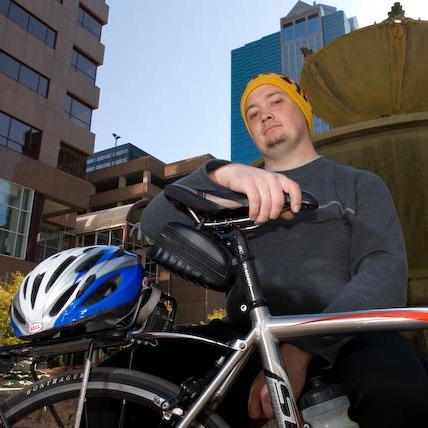
About a week ago, I got tired of the platform pedals and the ass-hatchet of a saddle. I swapped my SPDs and Bontrager saddle over from The Twelve. Those changes made the Wabi Special even more enjoyable to ride than before. The OEM saddle doesn't get along with me at all, and clipless pedals or rat traps go a long way on fixed gear. Without some kind of attachment system, high cadence spinning seems both disconcerting and dangerous. With clipless, I felt much more in control and more in touch with the pavement than before.
I'm probably going to be finished reviewing this bike at the end of this week. There will be a fixie-shaped hole in my life when I send this beauty back home to Los Angeles.
Showing posts with label fixie. Show all posts
Showing posts with label fixie. Show all posts
Tuesday, July 27, 2010
18.3 MPH Average

Wednesday, July 21, 2010
Fear.
I like storms. I even like riding in storms. It's not often that I fear the weather; Your chances of getting sucked up into a Swirling Vortex of Doom or getting struck by lightning are pretty slim.
Last night, I got scared.
The skies were ominous when I left, and there was a strong wind out of the north. I didn't have my waterproof backpack with me, so I'd wrapped my phone up in a plastic bag. I was ready for rain and headwind. Some co-workers offered me a ride home, but their sedans wouldn't accommodate my bike, and I didn't feel like messing with the bolted front axle to remove the wheel so it'd fit in a trunk. They wished me good luck. That made my day, at least.
Riding across 113th, there were a few times I was nearly blown straight off the road by crosswind. Once I got myself into a headwind situation on Santa Fe Trail Drive, I was okay. I had to put my sunglasses on because the wind was blowing debris at me with stinging force. Then came the first few sprinkles and even more wind, clawing at my forearms and calves. All while trying to hold a straight, assertive line on the road. A kind man in a pickup drove next to me for a while and asked if I needed a ride. I thanked him and waved him on. I'd later regret that.
After a few miles, the deluge set in, and it was like riding into a sandblaster nozzle. There was zero visibility and the driving rain caused burning pain on all my exposed skin, even my scalp as it drove its way through the vents in my helmet. Lightning strikes were landing way too close for comfort and finally drove me to find the nearest overpass to wait under for a while. It's easy to write off a lightning strike as a one-in-a-million probability until you've heard the sharp sound of arcing electricity right before you feel the thunder a few times in a row.
Shortly after getting back out on the road, I would find myself being passed far-too-closely by a lane-straddling semi as I tried to go over one of the gnarlier railroad crossings. Despite my assertive lane position, I didn't get nearly enough room, and I couldn't make a perpendicular cross like I usually do. The rear tire hit the second rail, lost traction, and tried sliding right out from under me. I managed to stay shiny side up without stopping, thanks to fixed gears' natural tendency to be easier to control in low-traction conditions. I would have looked for the plate number of the truck, but it had stopped to wait for a left turn and I didn't feel like waiting around.
The rest of the trip was uneventful as can be when you're dealing with storms. At least I felt refreshed when I got home, even if I did have to wring three gallons of water out of my backpack, clothes and shoes.
Tuesday, July 13, 2010
Behold, the watt.
 "In terms of Classical mechanics, one watt is the rate at which work is done when an object's velocity is held constant at one meter per second against constant opposing force of one newton."
Blah, blah, blah. What the hell is a newton anyway?
Just kidding. I'm a nerd. I know what all of this means. Basically, a watt is a way to express the rate at which work is being done. When you're dealing with electricity, volts x amperes = watts. I actually think that transposes to mechanics easier than the crazy jibberish above.
The weight you apply to the pedals is like Volts. The speed you're cranking on them is like amperes. The combined work being done can, in fact, be expressed in watts.
I mentioned this a few days ago: fixed gear doesn't seem to have slowed me down at all. When I first hopped on the Wabi Special, I gave myself twice the time to get to work, just in case. I figured that I'd have a hard time climbing hills. I also figured I'd have to take it slow going downhill. To me, this whole thing sounded like a recipe for a slower commute. I got to work as fast as usual. Maybe faster. I didn't have a cyclometer, but total elapsed time with stops was 25 minutes, which is par for the course. This has been puzzling me for a few days. I keep leaving a little early. I keep thinking maybe I'm just hammering it harder than usual to make up for the time. I keep getting to work in 25 minutes. The return trip home is also about the same. What's going on?
When I'm riding on my own, I tend to fall into this pace. It's not particularly fast, but it's not very slow, either. I always thought this had something to do with my pedaling cadence. I'd adjust my gearing to keep my cadence somewhat stable.
Riding fixed gear, though, I've found out that I have settled into roughly the same pace, even though my cadence is all over the place. I'm now starting to understand how this all works. It's not about cadence, it's about watts. Without being able to trade-off effort for crank revolutions with dozens of gearing combinations, I still exert roughly the same amount of energy per minute regardless which bike I'm on. I just push harder on the uphills than I normally would, and spin faster than usual on flat land. The same amount of energy exerted moves the bike roughly the same speed on average.
Bonus: the fixed-gear drivetrain is actually more efficient and feels more connected to the road. You'd have to try it to know what I mean. The end-result is a remarkably simple, efficient and fun way to get around, so long as you don't have many steep hills around.
Mystery solved.
Monday, July 12, 2010
Danger Panda
This shot from a few weeks ago got me a finalist spot in a photo contest on Brightkite, a service I use to help me blast my pictures, announcements and whatnot onto various social media platforms. The prize? A Brightkite T-Shirt.
Danger Panda time.
Friday, July 09, 2010
Remember the burn?
Those of you who started riding a bike in the last 5 years or so will probably remember with a certain fondness how badly the muscles in your legs hurt the morning after your first ride. My first few times riding 2 miles each way to the bus stop felt like huge journeys. When I woke up in the morning, my feet would ache. My quads and calves would burn.
For me, riding 6.2 miles each way now feels like a short and easy trip. It's highly enjoyable. When I wake up these days, I feel refreshed. Bike commuting does that to you. It gets you into better shape and changes your mood. And if you ride every day at a pace you enjoy, you really won't tone your muscles any more. They'll get used to it.
Yesterday, I rode 13 miles on the Fixed-Gear Wabi Special. It took me about a mile to get used to riding fixed gear Wednesday night. Yesterday's commute went great. Fixed gear is fun! Although I had to hop out of the saddle for some of the hills, It's really no more total work to get around on a fixie than it is with any other bike. Gears just trade effort for time and distance. You don't need to mash as hard on the pedals to climb in a lower gear, but you have to turn the cranks more times to get to the top. Total work done to climb a hill is roughly the same either way you do it.
One thing I noticed, though, is that fixed gear forces you to use a bunch of muscle groups that, as far as I can tell, most normal cyclists don't use too often. I could tell yesterday that some new muscles were being worked. This morning, I hurt in almost the exact same way I used to hurt when I first started riding. At least this time I know that this phase only lasts a few days.
Thursday, July 08, 2010
The Trains of Santa Fe Trail Drive
I go over six distinct railroad crossings each way on my commute. That's twelve per day. Lenexa doesn't really know how to maintain these crossings, as most of them are rough to ride across. This is amplified by the fact that these are local spurs with a very odd angle-of-attack, leading off the siding next to the mainline and into small yards where only a few cars at a time get dropped off to local businesses across the street.
Some people believe these crossings are vestigial rails, no longer used. Two of the six crossings have derails off the siding track. They are smooth and easy to cross because asphalt is butted up directly against the rails. Every so often, though, I see something like this on one of the remaining four spurs: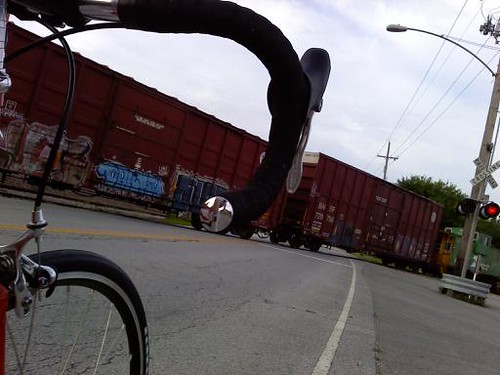
Hey, look! A caboose!
Cabooses are still often used on local deliveries such as this one, frequently book-ending the train with the engine somewhere in the middle. A conductor acts as the eyes and ears for the engineer. The caboose also contains a gauge showing brake line air pressure and enables the conductor to initiate emergency braking for the entire train.
In case you wondered, the little blinking red light (FRED, or Flashing Rear End Device) at the trailing end of most freight trains is a computerized device that provides roughly the same function as a conductor in a caboose. It monitors brake pressure through to the back of the train and has a blow-off valve to allow the engineer to expedite emergency braking from both ends of the air hose.
At any rate, I really wish someone would do something about these horrible crossings. The angle of these crossings plus the general blighted condition of the roadway near them often makes it uncomfortable for everyone. Cyclists have to find (and memorize) a safe line through each crossing, and motorists have to be patient, as it's one big no-passing zone. Santa Fe Trail Drive isn't terribly wide, but motorists and cyclists get along quite well. I've only been honked at one time and it was friendly (meep meep!) The right part of the road is in great shape with ample room for the Kansas-mandated 4-foot passing law, except at these crossings. There, I just take the whole darn lane as needed, but many cyclists are far too sheepish to do that.
Lenexa keeps piling asphalt into these crossings, but the locomotives keep rolling through, crushing and distorting it. I'm pretty sure Lenexa's doing it wrong, and I don't think it's anyone else's responsibility (e.g., land owners, railroad companies, etc...)
On a side note, today was my first commute on the fixie. I went on a little 3-mile jaunt last night, making a mock trip to the grocery store using small residential roads and mostly-empty parking lots to get myself familiarized with fixed-gear riding. Once I broke myself of my coasting habit, everything else fell neatly into place. It was an enjoyable ride to work this morning, and it didn't really take me any longer to get here.
Update: dvicci just linked me to this gem on Dave Moulton's blog via Google Reader. How timely!
Wednesday, July 07, 2010


Subscribe to:
Posts (Atom)